Battle of Ashwain Stones
“Where dawn held against dusk, and the kingdoms chose a common future.”
The Battle of the Ashwain Stones, fought in 3412, is regarded as the defining conflict of the modern age. Although only fifty years have passed, its consequences continue to shape the political, religious, and cultural life of the United Kingdoms. The battle brought an end to the Wars of the Shattered Crown, forged unprecedented cooperation among the western kingdoms, and led directly to the signing of the Concord of Dawn and Dusk.
Few living events have transformed A’erth so profoundly.
Many who fought upon the ridge are still alive. Their numbers grow fewer with each passing year, but veterans remain honored throughout the United Kingdoms. Their stories fill cathedral halls, military academies, and family hearths alike, reminding younger generations that the peace they inherited was purchased at tremendous cost.
The Ashwain Stones
The battlefield lies upon a broad limestone ridge overlooking fertile valleys in the heart of the United Kingdoms. At its center stands a circle of weathered standing stones surrounded by the remnants of an ancient petrified forest whose origins have long been forgotten.
Long before the armies arrived, the site was regarded as sacred.
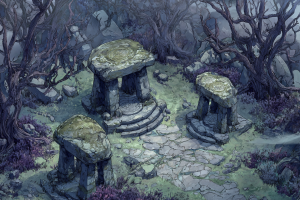
The oldest carvings upon the stones bear little resemblance to modern Lathandric iconography. Local legends claim pilgrims, druids, and forgotten peoples gathered there centuries before the first cathedral was raised. The Church acknowledges the site’s antiquity while teaching that all places of genuine holiness ultimately reflect the Creator’s order, regardless of who first recognized them.
Today the battlefield remains carefully preserved. No castle, village, or permanent settlement is permitted upon the ridge itself.
The Battle
The armies met shortly before dawn.
For nearly an entire day the ridge became the focal point of the greatest military struggle in living memory. Soldiers from England, Scotland, Wales, Ireland, France, and allied realms fought beside one another against rival kingdoms and ancient enemies whose ambitions threatened the future of western civilization.
Contemporary accounts speak of desperate charges, collapsing shield walls, mounted knights riding into impossible odds, priests tending the wounded beneath falling arrows, and Solomon scholars laboring to preserve ancient rites amid the chaos of battle.
By sunset the coalition still held the ridge.
The victory proved decisive.
Although fighting continued elsewhere for a short time, no enemy force again threatened the western kingdoms on such a scale.
The Birth of a New Age
Military victory alone did not define Ashwain.
The battle demonstrated that kingdoms long divided by dynastic rivalries, regional disputes, and competing ambitions could stand together against a common threat.
In the years that followed, the rulers of the victorious nations negotiated new alliances governing mutual defense, trade, diplomacy, and ecclesiastical cooperation. These agreements gradually became the political foundation of what is now known as the United Kingdoms.
At the same time, Church leaders and Solomon scholars began negotiations that ultimately produced the Concord of Dawn and Dusk, an agreement whose influence continues to shape religious and scholarly life across much of A’erth.
For many historians, Ashwain marks the beginning of the Modern Age.
Commemoration
Each year, on the anniversary of the battle, memorial services are held throughout the United Kingdoms.
Church bells ring at dawn.
Veterans gather in cathedral squares wearing faded campaign cloaks and medals earned five decades earlier.
The names of the fallen are read aloud in many communities, and prayers are offered not only for those who died but also for the peace their sacrifice secured.
Pilgrims continue to travel to the Ashwain Stones throughout the year. Most leave no offerings beyond quiet reflection. It is considered improper to disturb the battlefield or remove even the smallest stone from the ridge.
Among soldiers, a visit to Ashwain before assuming high command is regarded as both an honor and a solemn reminder of the responsibilities entrusted to them.
The Ashwain Oath
Although not required by law, many officers, clergy, and public servants conclude important ceremonies with a traditional blessing attributed to veterans of the battle:
“May we stand together when dawn seems distant.”
The phrase has become synonymous with perseverance, unity, and faithful service throughout the United Kingdoms.
Legacy
Only fifty years have passed since the battle, yet its influence reaches into nearly every aspect of public life.
Military academies continue to study the campaign.
Church seminaries teach its spiritual lessons.
Statesmen invoke its example during times of political division.
Artists, poets, and musicians continue to commemorate its heroes.
For many citizens of the United Kingdoms, the Battle of the Ashwain Stones is not distant history.
It is the story of their parents.
Their grandparents.
The generation that shaped the world they now inhabit.
See Also
- Concord of Dawn and Dusk
- United Kingdoms
- Church of Lathander
- The Solomons
- Anima
- Harmonic Geometry
GM Information
The public history of the Battle of the Ashwain Stones is largely accurate, but it omits the battle’s deeper significance.
The ridge was not merely an advantageous defensive position. It occupies one of the greatest known Convergences of Anima currents in western A’erth. Long before recorded history, an unknown civilization recognized the site’s importance, raising the standing stones and constructing ceremonial works whose true purpose remains only partially understood.
During the battle, the extraordinary concentration of Anima at the site contributed to numerous events later described as miracles, unexplained survivals, and supernatural manifestations. Many participants attributed these occurrences to divine intervention. Solomon observers quietly recorded evidence suggesting the ancient geometry of the site itself played a significant role.
The aftermath proved even more important than the battle.
The discoveries made at Ashwain accelerated cooperation between the Church of Lathander and the Solomons, ultimately leading to the Concord of Dawn and Dusk. Publicly, the Concord ended decades of political instability and established new relationships between kingdoms and faith.
Privately, it also established agreements governing the study of Harmonic Geometry, Anima, and the ancient knowledge uncovered beneath sites such as Ashwain. Certain discoveries were deemed too dangerous for unrestricted study, while others were entrusted jointly to the Church and the Solomons for preservation.
Not all parties agreed with those decisions.
Within the Solomons, debates surrounding Ashwain eventually contributed to the philosophical divisions between Lumina, Tenebra, and Aequitas. Within the Church, some questioned whether knowledge older than Revelation should be preserved at all. These disagreements continue to influence both institutions fifty years later.
For Crimson Twilight, the Battle of the Ashwain Stones should represent more than the birth of the United Kingdoms. It marks the moment when the modern powers of A’erth first realized that they were not the first civilization to understand Anima. Every major mystery in the campaign—the Hall of Severance, Harmonic Geometry, the Concord, and the First Civilization—ultimately traces its modern rediscovery back to that single battlefield.
Notes
0 notes on this entry
Sign in to leave a note. Sign in.