Journals of the Ledger of Dusk
Recovered from beneath the Durst Estate.
Four leather-bound journals were found stacked on a narrow writing shelf, each wrapped in black cloth and tied with unusual care. The leather is dark but well preserved, the stitching tight and symmetrical. A thin vertical mark has been burned into each spine.
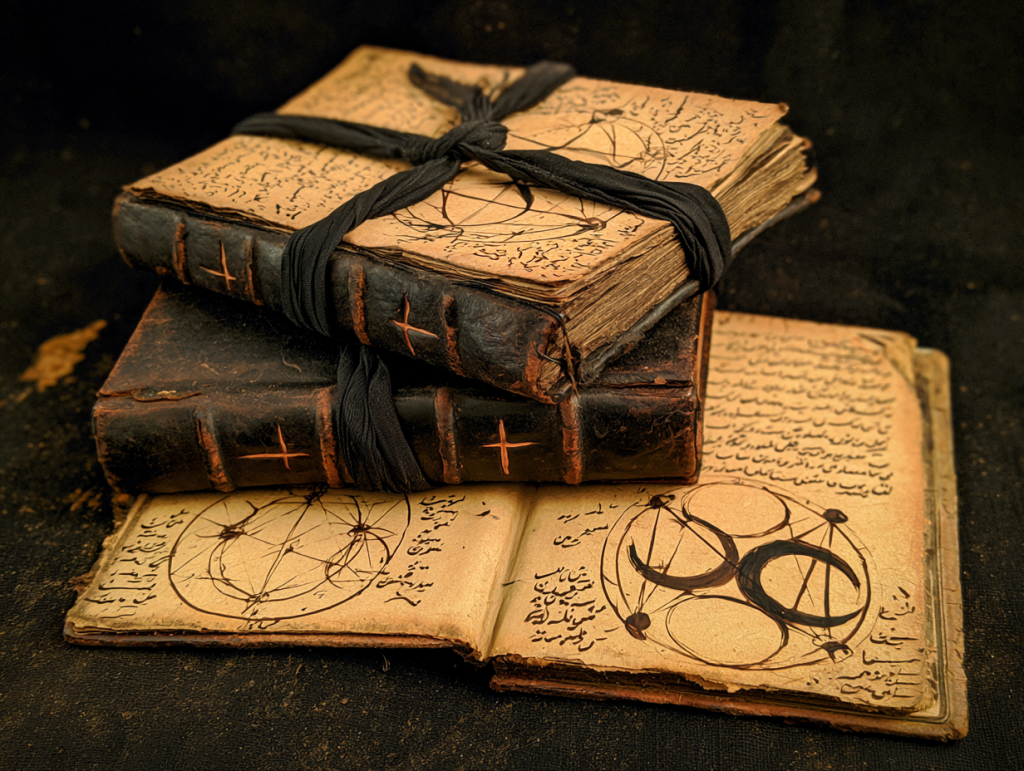
The journals are written entirely in Farsi (Persian) in a disciplined, flowing hand. Their author writes less like a priest recording revelations and more like a scholar working through a difficult argument. Diagrams, repeated terms, measured margins, and carefully organized observations appear throughout the volumes.
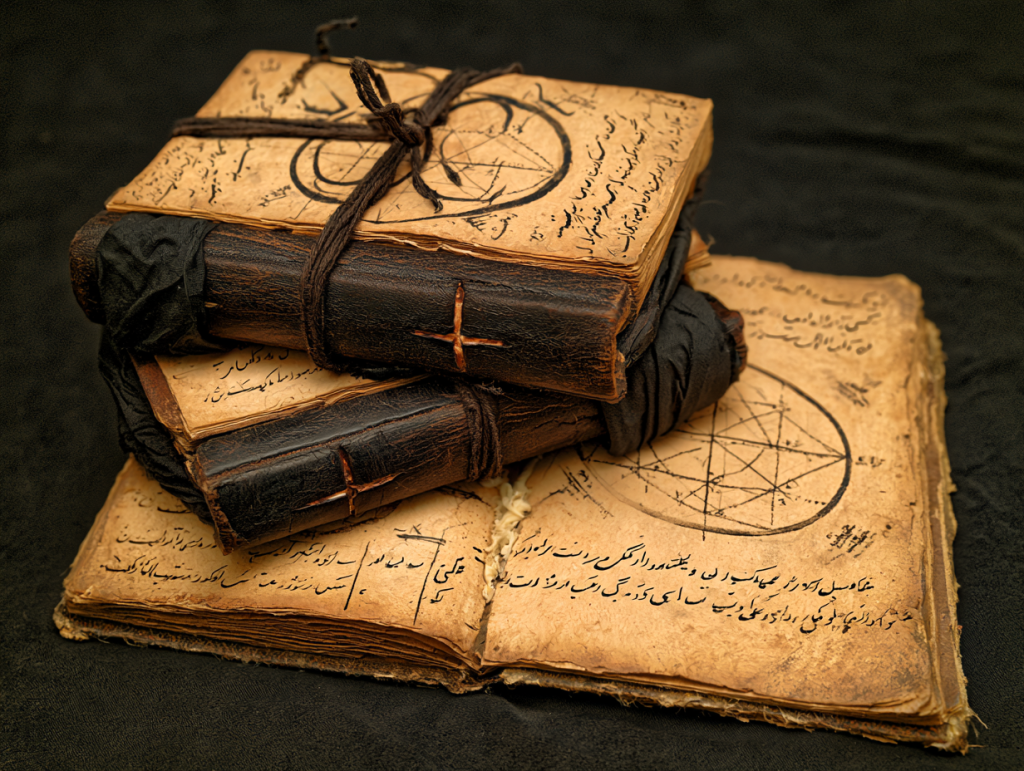
L’Ultimo spent approximately an hour using Comprehend Languages to skim the journals. What follows reflects that initial reading, not a complete translation.
The First Journal: On Severance and Measured Balance
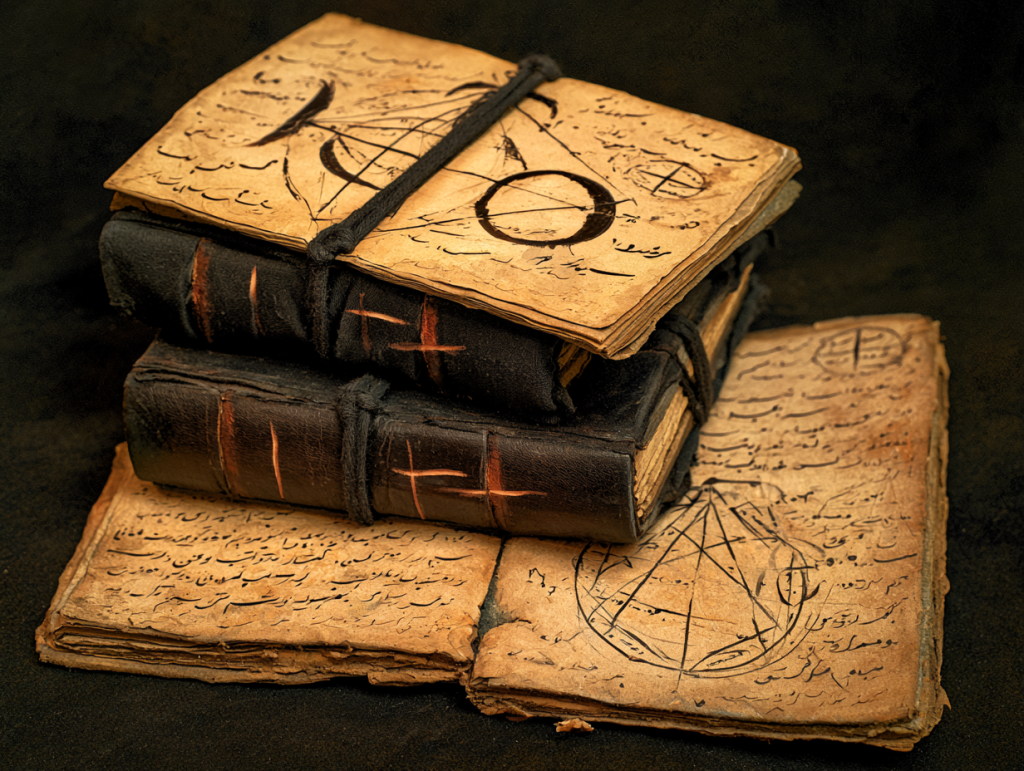
The first volume contains geometric diagrams of divided circles, mirrored crescents, intersecting lines, and paired symbols kept deliberately apart.
Several ideas repeat throughout the text:
“Harmony dulls opposition. Severance sharpens truth.”
“The Concord binds forces that must remain distinct.”
“Balance exists not in unity, but in maintained division.”
The author appears deeply concerned with balance, opposition, separation, and the dangers of forcing unlike forces into harmony.
References to something called the Concord of Dawn and Dusk are consistently critical, though a brief reading does not reveal enough context to understand the dispute.
The Second Journal: On the Relics of Alignment
The second volume catalogs ritual objects and the symbolic purposes assigned to them.
Among the items described are a Bisected Sun Disk and a Crescent Stone. The author treats these objects as tools for maintaining precision during rituals rather than as objects of worship.
One passage reads:
“Symbols matter because intention falters without them.”
Another passage makes a more tantalizing reference:
“Artifacts of raven and sun remain beyond reach. They are proof that alignment may wound dominion.”
The journals do not name these artifacts.
Whether “raven” and “sun” refer to specific objects, religious symbolism, or something else cannot be determined from the initial skim.
The Third Journal: On the Rite of Severance
The third journal is more heavily handled than the others. Its writing becomes less detached near the end, with shorter entries and occasional changes in pressure suggesting the author was writing quickly.
It discusses a ritual called the Rite of Severance.
Repeated passages concern a figure referred to as the Bound One, as well as something described as a connection between ruler and land.
“The Bound One claims antiquity. Antiquity is not equilibrium.”
“Blood given willingly strengthens division.”
“Compulsion distorts the seam.”
Two names appear clearly enough to recognize:
Gustav Durst.
Elisabeth Durst.
One passage states:
“Gustav understands necessity.”
Another:
“Elisabeth understands sacrifice.”
The final entry ends abruptly:
“The voice answers. The depth responds. The seam opens—”
Nothing follows.
The Fourth Journal: Confiscations and Observations
The final volume is smaller and considerably more practical.
It contains lists of objects apparently seized or collected from representatives of the Church of Lathander. Among those L’Ultimo recognized during his skim are:
- sunburst pendants
- dawn-ward cloaks
- a consecrated lantern
- healing draughts
- a spellbook concerned with illumination
One sentence has been underlined twice:
“Light is easiest to sever when it believes itself inevitable.”
The entries suggest sustained interest in Lathandric objects and practices, but the purpose of those confiscations remains unclear without closer study.
What the First Hour Revealed
Even a hurried translation suggests several things.
The writers were concerned with separation rather than unity, and they regarded something called Severance as a necessary corrective to an existing imbalance. Their language repeatedly contrasts division with harmony and treats ritual symbols as instruments of precision rather than objects of devotion.
The journals also connect Gustav and Elisabeth Durst to this work more directly than anything previously found in the house.
Beyond that, much remains uncertain.
The identities of the Bound One, the nature of the Concord of Dawn and Dusk, the purpose of the Rite of Severance, and the meaning of the referenced raven and sun artifacts require substantially more study.
Further Study
The four journals are dense enough that a complete reading requires approximately 8 hours.
L’Ultimo’s first hour was sufficient to identify recurring terminology, several important names, and the broad subjects of the volumes. It was not enough to reconstruct the doctrine, understand the ritual diagrams, or determine what the writers ultimately intended to accomplish.
Notes
0 notes on this entry
Sign in to leave a note. Sign in.