Ventrue Clan
Also Known As: The Clan of Kings, the Blue Bloods, the Lords of the Long Night
Classification: Vampire Clan
Primary Region: Central and Eastern Europe
Reach: Transregional
Status: Active, Influential, and Hidden
Overview
The Ventrue are a vampire clan associated with nobility, command, endurance, and the belief that power carries an obligation to rule. Their members have advised kings, commanded armies, governed isolated domains, and preserved noble houses long after their mortal founders passed into history. Where other vampires conceal themselves as merchants, scholars, or wandering predators, the Ventrue often stand close to recognized authority.
Not every Ventrue possesses a title. Clan members judge nobility by conduct as much as inheritance. A landless commander who preserves a settlement through winter might receive greater respect than a hereditary prince who allows fear and disorder to spread through their domain. Bloodline opens doors within the clan, but leadership must still be demonstrated.
Ventrue doctrine holds that society requires structure. Laws must be enforced, roads maintained, harvests protected, armies supplied, and disputes settled. Someone must make decisions when every available choice carries suffering. The clan’s defenders argue that Ventrue accept burdens others avoid. Its critics answer that the Ventrue call domination a burden because admitting they enjoy it would sound less noble.
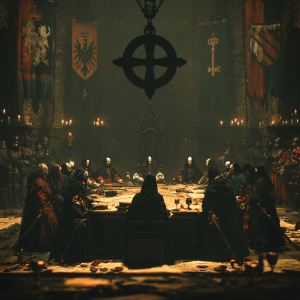
The clan is especially influential in Hungary, where ancient bloodlines, fortified domains, and powerful overlords shape political life. Hungarian rulers combine knightly ideals with ruthless pragmatism, governing lands where supernatural threats are woven into ordinary authority. No such ruler casts a longer shadow than Strahd von Zarovich, the immortal Lord of Barovia.
The Burden of Rule
Ventrue culture teaches that authority is not proven by possessing power but by maintaining what depends upon it. A ruler who wins a war and loses the harvest has failed. A noble who protects a castle while abandoning the surrounding villages has defended stone rather than a domain. A commander who demands loyalty but cannot inspire discipline is merely feared.
This belief can produce patient administrators, capable generals, and patrons who genuinely preserve communities through dangerous times. It can also justify tyranny. A Ventrue who believes only they understand the dangers facing a domain can dismiss consent, mercy, and dissent as luxuries afforded by those who do not bear responsibility.
Ventrue frequently ask what will happen after an enemy is defeated. They distrust revolutions without succession plans, religious reforms without resources, and moral declarations that leave ordinary people exposed to famine, invasion, or supernatural retaliation.
A Ventrue may respect a rebel who presents a workable system of government. They have little patience for someone who demands freedom while expecting others to repair the roads afterward.
Lineage and House
Lineage matters deeply to the Ventrue. Clan members maintain genealogies tracing sire to childe, record the domains governed by each branch, and preserve accounts of victories, failures, alliances, and disgraces.
These lineages are commonly called Houses, though they do not always correspond to mortal families. A Ventrue House might descend from a Roman general, a Bulgarian boyar, an Egyptian governor, a Norse war-chief, or a merchant prince whose descendants transformed economic control into political authority.
A House’s reputation follows its members. The childe of a respected ruler receives access and expectations. The descendant of a disgraced tyrant may spend centuries proving that the weakness of their lineage did not pass through the blood.
Ventrue introductions often include the name of a sire, House, and recognized domain. Concealing lineage is not automatically dishonorable, but falsely claiming a prestigious sire is among the clan’s most serious social offenses.
Not all Ventrue accept their inherited place. Childer created without consent may reject their House, while exiles sometimes build new lineages among soldiers, frontier communities, merchants, or people overlooked by older aristocracies.
Courts and Domains
Ventrue gather in courts organized around territory, obligation, and recognition. A court might govern a kingdom, city, trade route, military frontier, or scattered collection of estates.
The ruler of such a court is often called a Prince, though local titles vary. Voivode, Boyar, Castellan, Regent, First Magistrate, and Warden are common where mortal political traditions remain strong.
A Ventrue court typically includes:
The Prince, who claims responsibility for the domain and settles disputes that threaten its stability.
The Seneschal, who manages audiences, obligations, records, and the practical work of administration.
The Marshal, who directs military retainers, hunters, and responses to supernatural threats.
The Keeper of Oaths, who records agreements, feeding privileges, territory, and penalties for violations.
Recognized Houses, whose elders control districts, institutions, estates, or mortal families within the domain.
These roles are not universal. A frontier court might consist of a single elder, two childer, and a fortified village. What matters is that authority, territory, and responsibility are clearly understood.
Nobility and Merit
Ventrue disagree over what makes a worthy ruler. Traditionalists emphasize ancestry, education, discipline, and inherited obligation. They believe leadership must be cultivated across generations.
Merit-focused Ventrue argue that the clan’s purpose is to select those who can rule, wherever they are found. Such vampires create childer from military officers, judges, guild leaders, revolutionary governors, diplomats, and commoners who maintained order when nobles fled.
The disagreement is not simply philosophical. Older Houses fear that unrestricted advancement weakens the obligations that hold the clan together. Younger lineages answer that inherited privilege produces rulers skilled only at explaining why failure was unavoidable.
Both groups agree upon one principle: a Ventrue who claims authority becomes responsible for the consequences.
This responsibility does not guarantee compassion. A Ventrue may sincerely believe that executing several dissidents prevents a civil war, withholding grain preserves an army, or sacrificing one village protects an entire province.
Discipline and Command
The Ventrue possess supernatural powers associated with authority, presence, endurance, and control. Witnesses describe commands that become difficult to disobey, fear or admiration spreading through a crowd, and vampires continuing to fight through wounds that would destroy lesser undead.
Their influence is strongest when it reinforces an existing relationship. A soldier accustomed to obeying officers, a servant trained to defer to nobility, or a frightened citizen seeking protection may be especially vulnerable.
Ventrue do not rely exclusively upon supernatural command. Clan elders warn that compelled loyalty disappears when the compulsion ends. Durable authority requires habit, expectation, reward, fear, and a belief that obedience serves some greater order.
The most effective Ventrue rarely need to raise their voices. Rooms quiet when they enter because everyone present already understands that decisions will be made.
The Refined Hunger
Stories claim that Ventrue cannot feed freely from every mortal. Each vampire develops a particular preference or restriction carried through their blood. One might draw nourishment only from soldiers, members of an ancient family, people who have exercised political authority, or those who have willingly sworn an oath.
The precise nature of this restriction is closely guarded. Knowledge of what sustains a Ventrue can reveal their habits, servants, favored communities, and points of vulnerability.
Ventrue describe this selectivity as proof that their blood rejects the common and undisciplined. Critics describe it as a humiliating dependency hidden beneath aristocratic language.
A desperate Ventrue might surround themselves with suitable mortals, preserve a family across generations, manipulate a military unit into remaining nearby, or negotiate feeding rights with another domain. The apparent protection offered to such people can conceal the fact that they are being maintained as a resource.
Relations with Mortals
Ventrue often become patrons of noble families, military companies, courts, guilds, and civic institutions. Some maintain their mortal descendants, intervening when inheritance, scandal, or war threatens the family’s position.
A Ventrue household might provide land, education, military protection, favorable marriages, and access to political authority. In exchange, the family preserves the vampire’s resting place, supplies trusted servants, conceals irregularities in its genealogy, and provides blood when required.
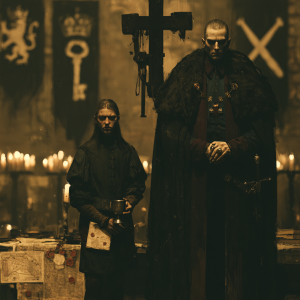
These arrangements can endure long enough to become tradition. Later generations may know only that a hidden patron protects the family and that certain rooms remain locked after sunset.
Some Ventrue genuinely love the communities under their protection. Their affection is possessive. A village protected by a Ventrue may be safe from bandits, invading armies, and rival vampires while remaining subject to strict law, heavy obligation, and punishment for attempting to leave.
Relations with Other Vampire Clans
Ventrue and Lasombra share an interest in command, hierarchy, and institutional power. Their disagreement concerns legitimacy. Ventrue emphasize recognized authority, lineage, and the preservation of domains. Lasombra are more willing to replace rulers who fail their tests of strength.
Brujah are the clan’s most persistent ideological rivals. Brujah accuse Ventrue rulers of treating stability as a justification for permanent domination. Ventrue answer that Brujah repeatedly destroy governments without protecting those left behind.
Tremere are valuable advisors on lineage, curses, and blood-borne threats. Ventrue courts restrict their access carefully, particularly where succession or the blood of a ruling House is concerned.
Nosferatu provide intelligence formal courts cannot obtain. Ventrue often treat them as necessary servants until discovering that the Nosferatu understand the domain better than its official administrators.
Malkavians serve as prophets, counselors, and uncomfortable witnesses. Ventrue rulers seek their warnings but frequently resent visions that undermine the appearance of certainty.
The Church of Lathander
The Church of Lathander condemns vampiric rule, but its relationship with Ventrue domains has often been shaped by practical necessity. Church missions require roads, protected settlements, access to food, and authorities capable of enforcing agreements. In contested regions, those authorities are not always mortal.
Some Ventrue permit Lathandric worship because it supports social discipline, healing, literacy, and civic order. Others tolerate the Church because suppressing it would provoke rebellion or attract military intervention.
The Church’s orders disagree over the limits of such accommodation. Missionaries might accept safe passage from a vampire lord while refusing direct obedience. Militant orders regard any agreement as temporary. Administrators are more likely to ask whether open conflict would leave the population worse off.
Ventrue understand these divisions and negotiate accordingly.
Symbols and Traditions
Ventrue symbols include crowns, scepters, lions, eagles, fortified towers, crossed keys, thrones, and signet rings marked with drops of blood.
Deep blue, black, burgundy, silver, and gold are common in their heraldry. Clan members tend toward formal, durable clothing suited to court, command, or travel rather than extravagant display without purpose.
Common Ventrue teachings include:
- “Authority is measured by what survives it.”
- “A crown is an obligation worn in public.”
- “Command what you are prepared to defend.”
- “The domain remembers every neglected duty.”
- “A ruler who cannot provide order invites another.”
- “Loyalty purchased for a night lasts exactly that long.”
- “The throne is never empty. It merely awaits the strongest claimant.”
A Ventrue receiving a formal guest commonly offers protection for the duration of the audience. The terms of that protection should be established clearly. A visitor who breaks hospitality may be judged more harshly than an open enemy.
Encounters with the Ventrue
Adventurers are likely to meet Ventrue through noble courts, military commands, fortified estates, trade negotiations, disputed inheritances, or settlements protected by a mysterious patron.
A Ventrue might hire the characters to escort an heir, recover a signet or treaty, suppress an uncontrolled vampire, investigate corruption among officials, restore order along a trade route, or remove a ruler judged incapable of protecting their domain.
The clan values competence. Characters who complete a task while preserving resources, protecting civilians, and anticipating consequences are more impressive than those who achieve victory through destruction.
A Ventrue patron may offer land, title, soldiers, safe passage, legal protection, or access to a court. Such rewards create obligations. The vampire expects service to become a relationship rather than remain a single transaction.
GM ONLY: Ventrue Clan
The Truth
For Crimson Twilight, Strahd von Zarovich is Ventrue.
His mortal life already embodied the clan’s defining traits: military command, dynastic duty, conquest, territorial rule, and the belief that protection justified absolute authority. The campaign material describes him as a brilliant commander who defeated the crusaders, claimed the valley, and sought the power necessary to protect his people before his pact transformed protection into possession.
Strahd’s transformation did not occur through an ordinary Ventrue Embrace. His pact imposed vampirism upon an existing soul, then bound that transformation to Barovia and the Dark Powers. His blood therefore carries recognizable Ventrue traits but does not fit cleanly within any established House.
Some Ventrue elders recognize him as one of the clan’s greatest rulers. Others call him the Crownless Branch, arguing that no sire witnessed his transformation and no House can claim him.
The dispute is academic within Barovia. Strahd does not require recognition from distant elders. His dominion is proof enough for him.
Strahd’s Refined Hunger
Traditional Ventrue can gain nourishment only from a particular class of mortal. Strahd’s pact transformed this restriction.
Strahd gains no true nourishment from a Barovian without a soul. He can drain such a person, create wounds, or kill them, but the blood leaves him hungry. Only about one in ten Barovians possesses a soul, making suitable prey far rarer than the population suggests.
This is one reason outsiders attract his attention. Their blood carries complete souls, memories, ambitions, and connections to a world beyond the Mists.
Tatyana’s reincarnations affect him differently. Her blood does not merely nourish him. It resonates with the pact, memory, loss, and the cycle that binds him to Barovia. Feeding from Ireena cannot satisfy his obsession because the hunger is not wholly physical.
Strahd conceals his limitation. Most servants assume every Barovian can feed their master equally. Those responsible for selecting victims quietly track unusual courage, creativity, devotion, or force of personality because such traits often indicate the presence of a soul.
The Ventrue of Barovia
Strahd permits no independent Ventrue court within Barovia. Castle Ravenloft is the court, and all lesser claims exist by his tolerance.
Ventrue visitors must acknowledge Strahd’s territorial authority. Those who refuse are expelled, imprisoned, destroyed, or permitted to act just long enough to expose their allies.
The clan’s Barovian presence consists primarily of:
- foreign envoys;
- bound or subordinate childer;
- mortal noble houses under vampiric patronage;
- administrators who reflect Ventrue methods without belonging to the clan;
- former rulers preserved as advisors, prisoners, or undead retainers;
- ambitious vampires hoping to learn how Strahd bound a domain to himself.
Strahd rarely creates true childer. A childe carries lineage, potential claim, and the possibility of succession. Vampire spawn are easier to dominate and possess no recognized standing among established Ventrue Houses.
Castle Ravenloft as a Ventrue Court
Castle Ravenloft operates as a court even when no formal gathering is underway.
Its hierarchy is communicated through access. Who may enter the castle? Who is received in a public hall? Who is permitted to dine? Who is escorted below? Who receives a written reply rather than silence?
Strahd’s household reinforces his authority through:
- military discipline;
- ceremonial hospitality;
- genealogical memory;
- surveillance through the Vistani and other agents;
- carefully distributed privileges;
- punishment that makes examples rather than merely removing enemies;
- the preservation of institutions useful to the domain;
- controlled displays of supernatural power.
The campaign’s existing history establishes Strahd as a conqueror, strategist, necromancer, and ruler who used intelligence, barbarian allies, undead troops, sorcerers, and warlocks to break invading armies.
Run Castle Ravenloft as the ultimate expression of Ventrue rule corrupted by isolation. Everything functions. Everything serves the ruler. Nothing is permitted to exist wholly for itself.
The Concord of Dawn and Dusk
The Ventrue were among the strongest vampiric supporters of the Concord of Dawn and Dusk.
They wanted predictable borders, recognized domains, limits upon Church-sponsored hunts, and procedures for resolving violations without renewed war. The Lasombra shaped much of the institutional secrecy surrounding the agreement, but the Ventrue supplied its political foundation: recognized authority is preferable to endless conflict.
Strahd’s role as a stabilizing ruler made Barovia central to the settlement. His domain contained supernatural threats, blocked military expansion through the region, and provided an authority with whom the Church could negotiate.
The failed Brujah rebellion beneath the Durst Estate demonstrated the alternative. Both Strahd and Church authorities allowed the horror to remain as a warning, embodying Concord logic before the agreement had a formal name.
Ventrue defenders of the Concord argue that it saved thousands from open warfare. Its opponents answer that it converted suffering into policy and granted tyrants legitimacy so long as their cruelty remained contained.
Both claims are true.
The Houses Beyond Barovia
The Ventrue are not united behind Strahd. Several Houses regard Barovia as a warning about absolute dominion.
Traditional Houses admire the stability he created but criticize his refusal to establish a succession plan.
Imperial Houses want access to Barovia’s military position, necromantic resources, and eastern trade routes.
Steward Houses believe a ruler must preserve the prosperity of a domain and consider Barovia’s decline evidence of failure.
Crusader Houses have allied with mortal churches and kings against rival vampires, arguing that disciplined cooperation with the living protects the clan better than isolated tyranny.
The Crownless are Ventrue without recognized lineage or domain. Some view Strahd as proof that authority can be seized without clan approval. Others hope defeating him will establish their own legitimacy.
These divisions allow Ventrue to appear as enemies, rivals, diplomats, and potential allies without reducing the clan to Strahd’s servants.
Vienna and the Western Courts
Vienna offers Ventrue influence without open vampiric rule. Its embassies, merchant houses, guilds, courts, military garrison, noble estates, and contested frontier position provide numerous institutions through which a patient patron can work. The city stands at a crossroads of trade and diplomacy between the United Kingdoms, Hungary, and the Kingdom of the Bulgarians.
A Ventrue operating in Vienna is likely to control obligations rather than territory. Loans, military appointments, caravan protections, noble marriages, guild charters, and diplomatic access can create a domain invisible on any map.
The Black Guild’s insistence upon controlled crime, arbitration, and avoiding actions that bring Church attention resembles Ventrue political logic, though the Guild is not itself a Ventrue organization.
A vampire patron might quietly support the Guild because predictable criminal activity is easier to govern than uncontrolled violence.
Goals and Methods
Immediate Goals
Ventrue connected to Barovia seek to determine whether the newly arrived characters are potential servants, destabilizing threats, worthy opponents, or possible successors to institutions Strahd expects to outlive.
Foreign Ventrue want information about Strahd’s pact, his selective hunger, the Mists, the reincarnation of souls, and the extent to which his authority depends upon the land.
Strategic Goals
Strahd seeks to preserve his absolute authority, secure Ireena, prevent rival factions from uniting, and ensure that every meaningful act of resistance ultimately reinforces the belief that only he can govern Barovia.
Other Ventrue seek access to Barovia’s trade position, supernatural knowledge, noble families, and political agreements. Some want Strahd weakened without allowing the valley to collapse.
Existential Goals
The clan seeks to remain the lineage most closely identified with rulership. Individual Houses imagine different futures: vampire kings ruling openly, hidden patrons guiding mortal governments, or mixed courts in which living and undead authorities preserve order together.
The central Ventrue fear is not destruction. It is irrelevance: a world that learns to govern without them.
Methods
Ventrue methods include:
- patronage;
- military protection;
- laws and formal agreements;
- genealogical influence;
- control of land, food, roads, and trade;
- arranged succession;
- supernatural command;
- selective punishment;
- hospitality used to create obligation;
- forcing rivals to choose between imperfect stability and visible catastrophe.
A Ventrue does not need everyone to love the existing order. They need enough people to fear what might replace it.
Knowledge of the Ventrue
The following information is cumulative. Characters from noble, military, diplomatic, or vampire-hunting backgrounds may know the DC 10 information without a check.
Intelligence (History)
DC 10: Ventrue are a vampire clan associated with nobility, military leadership, political authority, and old bloodlines.
DC 15: They organize themselves into Houses and territorial courts. Lineage matters, but members are also judged by their ability to govern and protect a domain.
DC 20: Ventrue have negotiated agreements with mortal governments and religious authorities, especially where open warfare threatened trade, settlements, or regional stability.
DC 25: The Ventrue were influential in establishing the political principles behind the Concord of Dawn and Dusk, including recognition of territorial authority and limits upon unsanctioned conflict.
Intelligence (Religion)
DC 10: Lathandric teachings describe Ventrue as tempters who offer safety in exchange for obedience.
DC 15: Church missions have sometimes negotiated passage, sanctuary, or protection from rulers suspected of vampirism.
DC 20: Restricted writings debate whether cooperation with a stable undead ruler can be justified when immediate war would devastate the mortal population.
DC 25: Some Church administrators helped preserve Ventrue-controlled domains because those rulers contained more chaotic supernatural threats.
Intelligence (Arcana)
DC 12: Ventrue possess supernatural powers associated with command, emotional influence, and extraordinary endurance.
DC 16: Their commands are more effective when they reinforce existing habits of obedience, fear, duty, or loyalty.
DC 20: Each Ventrue possesses a restricted feeding preference. Blood outside that preference can be consumed but provides little or no nourishment.
DC 25: A Ventrue’s preference may reveal something about the vampire’s mortal identity, sire, first feeding, or understanding of whom they consider worthy.
Intelligence (Investigation)
DC 12: Several noble, military, or mercantile decisions benefit the same hidden patron.
DC 16: The patron’s influence is maintained through obligations, appointments, and access rather than direct ownership.
DC 20: A mortal family has been preserved across generations to serve a patron whose identity never appears in official records.
DC 25: The apparent ruler is not the true center of the network. Authority rests with whoever controls succession, food, military loyalty, or recognition of legal claims.
Wisdom (Insight)
When negotiating with a Ventrue or senior retainer, the GM can call for a Wisdom (Insight) check.
DC 13: The speaker is assessing whether the character can be trusted with responsibility.
DC 17: The offered reward is intended to create an ongoing obligation.
DC 21: The Ventrue has identified what the character wants authority over and is deciding whether to grant, threaten, or delegitimize that claim.
Running the Ventrue
Ventrue should feel authoritative without becoming identical aristocrats. A Ventrue might be a frontier commander, merchant governor, former revolutionary, military priest, elected magistrate, or matriarch whose family survived because she made every difficult decision herself.
They do not all boast about nobility. Many consider visible vanity evidence of an insecure ruler.
When portraying a Ventrue, determine:
The Domain. What people, land, institution, or system do they claim responsibility for?
The Duty. What obligation do they fulfill well?
The Failure. What consequence of their rule do they refuse to acknowledge?
The Succession. Who would inherit their authority, and why have they avoided preparing that person?
Ventrue admire composure, foresight, discipline, loyalty, administrative competence, and people who accept responsibility for outcomes.
They despise public disorder, broken oaths, wasteful violence, leaders who blame subordinates for their failures, and rebels who cannot explain what comes next.
A Ventrue may forgive insult more readily than incompetence.
Signs of Their Presence
Use the following details before introducing a Ventrue or their court:
- Portraits show generations of rulers accompanied by the same unnamed figure.
- A noble family maintains one room for a guest who visits only after sunset.
- Soldiers obey an unrecognized civilian without asking for credentials.
- Tax records are harsh but unusually consistent.
- A village receives protection no neighboring settlement can explain.
- Every important contract contains the same archaic clause.
- A disputed heir receives unexpected witnesses, funds, and military support.
- Servants refer to a patron by title but never use a name.
- A household’s oldest members display identical puncture scars.
- An official refuses a bribe but accepts a personal oath.
- A banquet includes carefully selected guests while several more powerful nobles are excluded.
- A ruler’s death is followed by an immediate, orderly succession despite years of public uncertainty.
- Bandits avoid one road even though no patrols are visible.
- A local lord knows details of crimes committed before their birth.
Representatives
The Prince
A Ventrue ruler who claims responsibility for a city, domain, or political network. The Prince expects recognition before negotiation.
The Seneschal
An administrator who manages obligations, audiences, succession, and the information that reaches the ruler. The Seneschal may possess more practical power than the court’s nominal leader.
The Marshal
A commander responsible for armies, vampire hunters, and supernatural threats. The Marshal respects competence and evaluates adventurers as potential assets.
The Keeper of Oaths
A historian, judge, or ritualist who records agreements and interprets obligations. They remember promises made generations before the current participants were born.
The Landless Heir
A Ventrue whose domain was destroyed or inherited by a rival. The heir seeks recognition, territory, and proof that their House remains worthy.
The Steward
A vampire who genuinely protects a mortal community, ensuring food, safety, and order while quietly controlling every significant choice its people make.
The Favored Mortal
A governor, general, guildmaster, or noble descended from generations of servants. They may know the patron’s nature and consider the arrangement necessary.
Resources and Influence
A Ventrue court might possess:
- noble titles and genealogical claims;
- soldiers, guards, and veteran commanders;
- fortified estates and castles;
- control over roads, bridges, tolls, and trade routes;
- grain stores, land, and taxation;
- judges, heralds, scribes, and diplomats;
- mortal families bound by inherited obligation;
- recognized authority among other vampires;
- records of treaties and succession;
- supernatural command and exceptional resilience;
- safe houses maintained as official residences;
- alliances with churches, guilds, and military orders.
Their influence is limited by rival claimants, dependence upon suitable blood, rigid traditions, succession disputes, rebellion, and the danger that their domain can survive without them.
Complications
The Good Tyrant
A Ventrue ruler is oppressive but keeps the region safe from invasion, famine, and worse supernatural predators.
The Wrongful Heir
The lawful successor is incompetent. A Ventrue patron supports a more capable claimant whose ascent requires fraud or murder.
The Protected Herd
A village prospers under secret vampiric protection. Its people are also forbidden to leave because several families provide the patron’s preferred blood.
The Oath of an Ancestor
A character’s family promised service to a Ventrue generations ago. The vampire considers the agreement active.
The Empty Throne
A ruler has died, but the Ventrue court refuses to acknowledge any successor. Several factions begin governing independently.
The Necessary Rebellion
A Ventrue knows that the current government must fall but wants the uprising delayed until food stores, military command, and succession are secured.
The Suitable Soul
Strahd’s servants identify a character or NPC as possessing blood capable of nourishing him. The person receives protection that gradually becomes confinement.
Adventure Use
The Banquet of Claimants
Five heirs attend a formal banquet where an ancient Ventrue will recognize one as the legitimate successor. One claimant plans to murder the vampire before judgment is given.
The Road That Never Falls
A mountain road remains safe despite war, wolves, and supernatural attacks. Travelers unknowingly pay tribute through a noble toll house serving a hidden Ventrue warden.
The Tenth Name
A census contains a private mark beside certain Barovians. The marked individuals all possess souls and are being tracked for Castle Ravenloft.
The Crownless Envoy
A foreign Ventrue offers aid against Strahd but demands recognition of their claim over Barovia after his defeat.
The Steward’s Harvest
A prosperous estate produces food despite blight across the surrounding lands. The harvest is protected by an agreement requiring one member of every household to serve in the manor.
The Last Order
A dead general’s soldiers continue obeying commands delivered in sealed letters. The handwriting belongs to a Ventrue patron who has directed the army for three generations.
Development
Ventrue become more cooperative when characters:
- fulfill an oath despite personal cost;
- protect civilians while pursuing victory;
- preserve useful institutions;
- demonstrate military or administrative competence;
- present a workable plan for what follows a ruler’s defeat;
- accept responsibility for unintended consequences;
- negotiate clearly and honor hospitality;
- recognize authority without surrendering judgment.
Ventrue become hostile when characters:
- break formal agreements;
- create disorder without preparing an alternative;
- humiliate a ruler before their dependents;
- threaten a protected population;
- interfere with succession;
- mistake restraint for weakness;
- expose a feeding arrangement without protecting those dependent upon it;
- demand power while refusing obligation.
An alliance with the Ventrue should provide structure, resources, and protection while raising a persistent question: At what point does accepting a ruler’s protection become accepting the ruler’s claim over you?
Notes
0 notes on this entry
Sign in to leave a note. Sign in.